blogger counters

Pages

Showing posts with label cemeteries. Show all posts

Thursday, October 28, 2010

return to Crespières, part 2 . . .

Ever since memory (at least in my adult life) when life crowds in on me, a voice inside echoes I want to go home!  And, ever since memory (at least in my adult life), I ask the voice inside and where is home?  I may go to my grave with that question still unanswered . . . and maybe find that answer, at last, on that other side . . .

But, every now and again this side of heaven, I sense what it must mean to be going . . . home?

August 4, 2010, was such a day.  There was the sign welcoming us to Crespières . . .  L’Eglise St. Martin with its familiar steeple, its locked door. . . The mairie with the marble plaque honoring its children, my great-grandfather among them . . .  The road—rue Moncel—beckoning me . . . home?

I walked ahead of the others.  Looking for redemption maybe?  Redemption is such a personal event, if it comes at all.

Many years ago—December 28, 1986 to be exact—I had walked this same road, this same quest for finding that elusive sense of home I so believe existed here. I had come to this moment and place in time so filled with hope, expecting . . . je ne sais quoi? . . . to be embraced as a long-lost child of that community? To recognize  . . . home?  I wasn’t.  I didn’t.

Something as trivial as struggling to explain, at the charcuterie, how my husband wanted our sandwich meat sliced . . . The young man behind the counter—how much he reminded me of my own brother—unable to contain his amusement at my broken attempt to communicate in his language . . .  I think the culinary outcome was other than what I had tried to communicate.  I think that what mattered most, though, was the breaking of my fragile spirit in that place, that moment in time. 

I stood across the street—rue du Grand Trou—that December afternoon, wondering which of two houses was the one of my not-quite-memory.  I had forgotten to bring the address.  I did not dare to ask . . .  Did not dare even to ask if my great-uncle Georges still lived in that village, if I might stop by to visit. 

At Orly, that New Year’s Day, I found his address in a telephone directory, wrote it down, wrote to him on my return.  This was his reply.

Nous aurions eu l’honneur de faire votre connaissance . . .
We would have been honored to meet you . . .
Nous esperons que votre voyage ce renouvellera . . .
We hope that this will make you want to return . . .
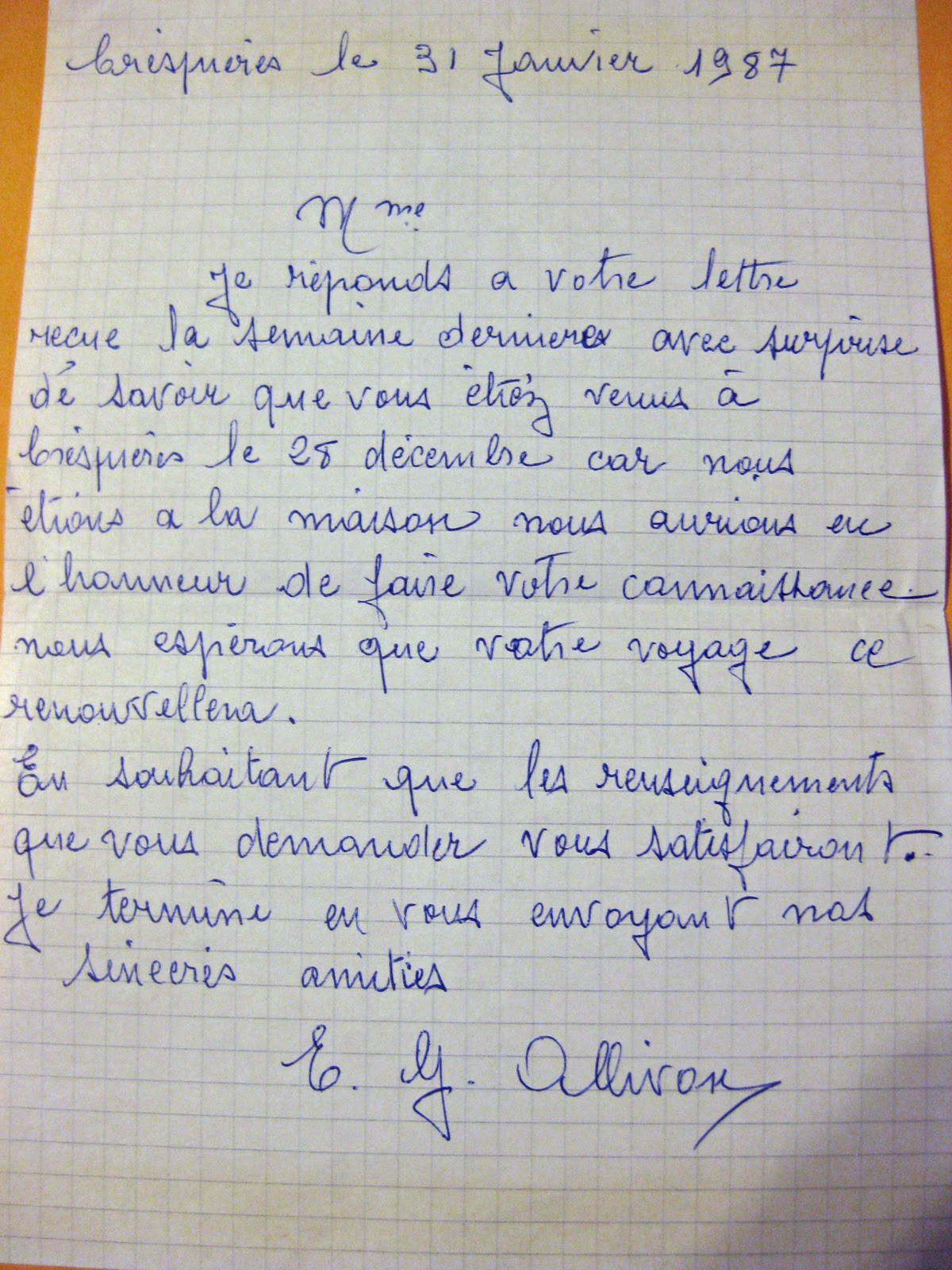

I did not understand the signature on the letter at that time: E. G. Ollivon.  My mother said his first name was Georges . . . and she did write to him after reading this letter . . .  It was only after visiting his grave this August—where he rests with his wife, Emilie—that I understood . . .

Georges was so very right.  I had no choice but to return . . .  home?

To be continued . . .

Sunday, October 24, 2010

la cimetière a Crespières—le 28 décembre 1986

Searching for other old photos this afternoon and stumbled across these three, taken on my first visit to that cemetery, my first opportunity to visit my grandparents’ final resting place . . . 

So much has changed over time.  No need then for the grave rubbings, not that we yet knew to do that to preserve engravings worn away by time, the elements . . .  Victorine’s name is clear.  Yvonne’s tombstone still radiant—with the hyacinths we remembered to purchase at a local floriste, with the shells brought from South Carolina beaches to share with my grandmother who had once walked another Carolina’s beaches with me, who had gifted me with shells from her side of the Atlantic . . .


Those who know me well know why these flowers, why this shell . . .

I had one very special shell and two very special flowers with me when we visited Yvonne’s grave this August . . . discovered them days later, tucked safely away where they remain still . . .  Too caught up in the emotions of this visit, so very different from the last, that I did not remember their presence. 

Perhaps I was not meant to remember . . .

Friday, October 8, 2010

what we learned about grave rubbings, teamwork, and faith . . .

If my granddaddy-from-across-the-wide-Atlantic could forgive my throwing his hat out his second-story windows when I was two, hopefully he’ll be smiling from his vantage point in the afterworld at my at times somewhat-irreverent story here of our pilgrimage to his final resting place, that also of his parents . . .

And hopefully my genealogist daughter—on this side of heaven so I’ll be hearing or reading what she thinks—will forgive me too.

It’s hard being the resident expert.  Kimberly should know!  And she was our genealogist guru as we went cemetery-traipsing throughout France in August.  Our thoughts that day were about the flowers we had forgotten to bring as tributes to those gone before us.  We were not prepared to meet our ancestors’ more basic needs or to take away with us proof, beyond that which our cameras could capture, of their final imprints on this earth.

The cemetery was not as I had remembered.  The dense hedges that shrouded the feet of my grandparents and great-grandparents were absent from my mental sketches of our other visit to their graves more than twenty years ago. I feared that time had erased even these in perpetuity tombs, that the communal ossuary might have been their fate.

My memories, marked on the Google Earth map I carried, were time-warped . . .

We found them.

A days’-dead bird was Grandmaman Yvonne’s only tribute.  We had brought her fruit from her garden, gathered snail shells from the cemetery paths, pulled garlands of morning glories . . . We were there that day, just not in our own name but to honor Yvonne in her only daughter’s name, in the name of my mother who could not bring herself to make this painful journey back in time and memory. 

In one corner of the cemetery, as in many of the cemeteries we visited, there was water.  Albrecht, my son-in-law, offered his shirt as a scrubbing rag.  We scoured the black marble until it shone, offered Yvonne our small tokens and our gratitude, gratitude for her long-ago letting-go of her only child. Three of us there that August day—Kelsey, Kimberly, and I--walk this earth because of her selfless gift . . .

Finding the other grave--the vault where Granddaddy René and his parents, Victorine and Ernest, sleep—was not as easy.  Like so many in that cemetery, a lichen-streaked granite slab, only faint etchings remaining of the names of those interred beneath . . .

in perpetuity . . .

Ernest Theodore Ollivon gave his life for his country in the opening days of World War I.  His name is the first on the plaque at the mairie, the plaque memorializing the thirty children of Crespières mort pour la France (and the one disparu) so that their homeland might remain free.
 
The metal plaque marking his grave
has withstood the ravages of time, as has, to my utter amazement, the ceramic photograph of my grandfather, the last family member entombed in that family vault.  But not so the names and dates engraved in stone . . .  Did Victorine sleep there too?  So I believed but I had never known . . .

A grave rubbing would tell us.  Kimberly knew how, of course—this was her trade, her expertise.  But we were in another world, in a borrowed car, out of our element and unprepared.  I had a notepad, lined blue paper, pages to spare . . .  Lead in the pencils I always carried . . .  Slow going . . . until . . . Albrecht remembered . . . was it from long-ago Scouts learning he said?  Leaves—green, green leaves and this was August—might work.


And they did!

What those that come after us will see in these photos, I believe, is not so much the names of the dead but the hands of the living . . .

Saturday, September 18, 2010

Cimetière de Levallois-Perret

Not every Parisian of artistic fame is buried in the four cimetières where tourists throng.

Paying my respects at the tomb of Gustave Eiffel, even if just virtually, is on my to-do list this weekend.  After all, he not only designed the awe-inspiring thousand foot Parisian tower but he also engineered the internal structure supporting Bartholdi’s masterpiece, Liberty Enlightening the World! 

I found his grave, at Cimetière de Levallois-Perret.

One other Parisian of artistic fame is also buried there. (Theirs are the two “famous” graves on that cemetery’s roll call . . .)  My first connection to him is from the long-ago days of “vinyl” music.  I still have that collection, recordings themselves of original player piano rolls . . .  My favorite among them is Maurice Ravel playing Maurice Ravel . . .  My second connection is to a very special selection from that recording: “Pavane for a Dead Princess.”  I’m not sure I’ve ever known to whom that piece was dedicated . . . but my clarinetist middle child, Michelle, chose to learn and to play that infinitely sad, yet infinitely beautiful, selection in a competition years ago.  “Pavane” is, for her, what Galway’s version of Gluck’s “Dance of the Blessed Spirits” is for her sister, in my memory of those days in which our home was filled with their music-making . . .

Gustave and Maurice, you have blessed my life.  Resquiat in pace!

Thursday, September 16, 2010

la dame de fer

Her timeline has a new entry this week on Wikipedia:

14 September 2010
Both the Eiffel Tower and Champ de Mars were evacuated following a bomb threat. And after a search of the area, no bomb was found. The tower and Champ de Mars were reopened the next day.

What was the caller thinking? 

Hitler failed both to reach her summit (the French cut her cables) and to engineer her destruction (placed the order but did his General listen?).  Scheduled for dismantling in 1909, after her World’s Fair permit ran out of time, she’s still standing tall more than a century later.  Even the pen—mightier than the sword, right?—has left nary a scratch on her reputation.  Guy de Maupassant—one of my now-sleeping literary icons whose tomb I searched for in vain at Montparnasse (I wonder where Gustave Eiffel is buried?)—reportedly ate daily in one of her restaurants, saying this was the only place in Paris without a view of the monument he so disdained.  Alexandre Dumas (I’ve read his The Count of Monte Cristo in French and lived to tell about it) would have agreed with him . . . I don't!

I think my favorite Wikipedia tidbits (had heard most before but love this free exchange of mostly correct information) are the full glass ones. Like the first entry in her timeline there:
10 September 1889
Thomas Edison visited the tower. He signed the guestbook with the following message—
To M Eiffel the Engineer the brave builder of so gigantic and original specimen of modern Engineering from one who has the greatest respect and admiration for all Engineers including the Great Engineer the Bon Dieu, Thomas Edison.

Or maybe the reminder about those awesome World War I Taxis of the Marne (her communication powers were tapped for that initiative).

In my own personal timeline will be forever etched these two dates:
August 2, 2010: the day I kept my promise to return to Paris and my first view of our dame de fer in her evening splendor . . .
August 6, 2010: the day I rode to her summit and gazed down at her city, wondering what that lovely green park at her feet was called, about its history. . .

Champs de Mars . . .  How could I not have known?

I know now J !


Sunday, September 12, 2010

Montparnasse . . . walled fortress of the dead

France fortifies well her cities of the dead.  I was to learn, this summer, that the high-walled estates we came across--in the heart of Parisian neighborhood, on prime Brittany coastlands, wrapped around three sides of village churches, in the middle of centuries-old farmland--were indeed cimetières, medieval-village-like in their clusters of crumbling stone edifices, irregular layouts, cobblestoned or otherwise stony paths.  And almost always the flowers, florist-shop luxurious in the clement climate of August in northern France.  And museum-quality statuary, perpetual tributes to those who have travelled before us to our next world.

Our first cimetière was Montparnasse.  Turned away after our first toolongwaitingline experience at the catacombs, we decided to explore this nearby cemetery.  It almost eluded us, posing, as it did, as someone's high-walled estate.  We had hoped for maps of the cemetery itself, with names of the famous dead buried there and the locations of their final resting places.  But Montparnasse was in flux, restorations and relocations alike. No maps to guide the feet of the curious, save for this one . . .

"Génie du sommeil éternel" (The Spirit of Eternal Sleep) given to the city of Paris by Horace Daillion in 1902
The names listed there read like a litany of my French literature immersion at Duke so many years ago: Baudelaire, Maupassant, Sartre.  I was to search in vain for their tombs, bypassing in my literary-icon state of awe the names of those to whom I have a deeper connection.  Jean-Pierre Rampal, the French flautist who inspired James Galway who inspired my daughter Kimberly (who had the privilege of meeting him backstage when we attended one of his performances).  Frederic Auguste Bartholdi who designed the Liberty Enlightening theWorld, the statue that guards the Ellis Island wall where my mother's name is, much to her dismay, engraved for all posterity.

Cemeteries in Paris are relatively recent cities, a mere two centuries old, created by order of Napoleon I.  Their predecessors were emptied, their denizens entombed in the catacombs of Paris, in the eighteenth and nineteenth centuries.  Montparnasse Cemetery lies to the south of the Paris of the early 19th century; Père Lachaise to the east; Montmartre to the north; Passy near the Champs-Elysees. 

One somber note on the nature of man this side of that other world . . . Kelsey, my granddaughter, was to learn at seventeen what her mother learned on her first visit abroad at seventeen . . . hold tight to what you value; someone is watching.  Albrecht replaced her camera, last seen on a cemetery bench,  before dinner that evening--all but her awesome airplane flight sunset and firstdayinParis photos.  And I learned that my stumbling command of the French language was much too elusive when asked to speak on demand (I remembered the word for camera long after we left the grounds).

Montparnasse was the first of many French cemeteries we explored over those ten days, some infinitely more memorable because our ancestors are sleeping  there . . .  but it still ranks high on my list of places to visit/revisit.  And return to this city of the dead I shall, someday . . . in time and space.

Monday, September 6, 2010

Où est elle, la Mort? in the Catacombs of Paris . . .

The Catacombs of Paris was not on my list of places to visit during our ten-day whirlwind excursion, but, as families do, we each put in our wishlist of experiences and endeavored to accomplish them all.

I'm glad I went . . . but agree with the caveat that this is not a pilgrimage for the faint of heart or spirit . . .

I knew that I would see the mortal remains of thousands of Parisians whose bones had been ceremoniously removed, during the 18th and 19th centuries, from church cemeteries and laid to rest in the Empire of the Dead in the tunnels below Paris.  I understood that, given the nature of medical science in that era, these reburials were deemed essential to the prevention of epidemics, the preservation of human life. Indeed, the artistry with which these bones were arranged is itself testimonial to the reverence with which they, and the souls they represented, were treated.

What I was not prepared for was those long ago voices, long-dead poets and philosophers, speaking to me of death . . .
Where is Death? Always future or past. She is hardly present when, already, she is no longer here.


How often have we heard the admonition to live our lives as though each day is our last here on earth?  In the Catacombs of Paris, we are reminded in the language of the ancient Romans and the Catholic faith and in the language of the Parisians entombed there.

The two-mile visitor's walk (of the 200-300 subterranean miles tranversed by these tunnels) is not entirely the domain of the Empire of the Dead.  The catacombs were originally stone quarries. 
Artifacts from that era include the artesian well at left and the sculpture at right, created by M. Dure, a quarry inspector, in the image of the French Port-Mahon fortress where he had once been imprisoned (early 1700's Minorca?).
If you want to know more about the Catacombs of Paris, Heather Munro's special to the Star Tribune, published in October 2009, makes excellent reading!